Analysis Of Financial Performance of The Regional Revenue and Expenditure Budget in The Pematangsiantar Regional Regional Management And Revenue Agency for the 2021-2023 Period
DOI:
https://doi.org/10.36985/arfwf671Keywords:
Financial Performance, APBD, Independence Ratio, Efficiency Ratio, Harmony RatioAbstract
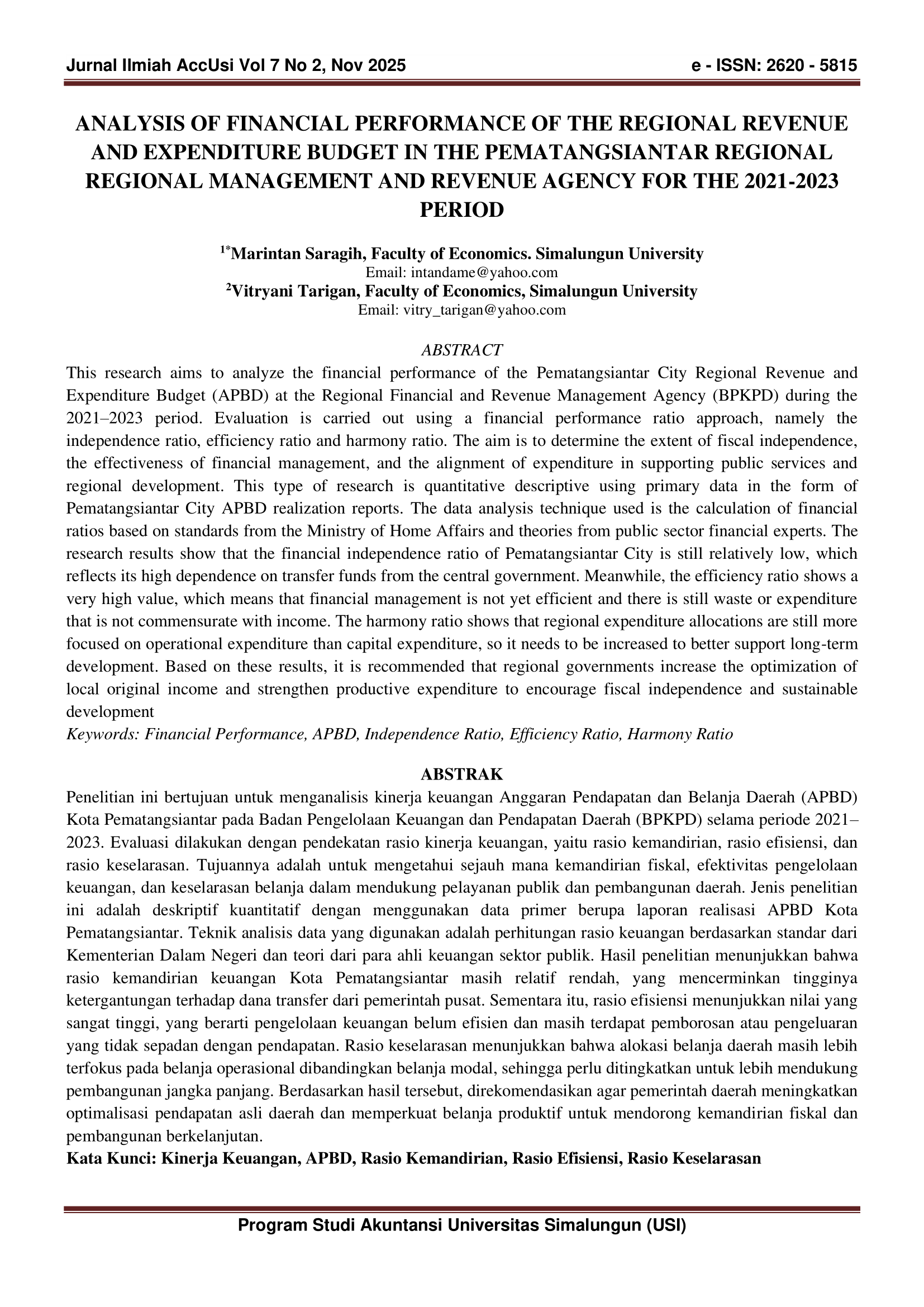
This research aims to analyze the financial performance of the Pematangsiantar City Regional Revenue and Expenditure Budget (APBD) at the Regional Financial and Revenue Management Agency (BPKPD) during the 2021–2023 period. Evaluation is carried out using a financial performance ratio approach, namely the independence ratio, efficiency ratio and harmony ratio. The aim is to determine the extent of fiscal independence, the effectiveness of financial management, and the alignment of expenditure in supporting public services and regional development. This type of research is quantitative descriptive using primary data in the form of Pematangsiantar City APBD realization reports. The data analysis technique used is the calculation of financial ratios based on standards from the Ministry of Home Affairs and theories from public sector financial experts. The research results show that the financial independence ratio of Pematangsiantar City is still relatively low, which reflects its high dependence on transfer funds from the central government. Meanwhile, the efficiency ratio shows a very high value, which means that financial management is not yet efficient and there is still waste or expenditure that is not commensurate with income. The harmony ratio shows that regional expenditure allocations are still more focused on operational expenditure than capital expenditure, so it needs to be increased to better support long-term development. Based on these results, it is recommended that regional governments increase the optimization of local original income and strengthen productive expenditure to encourage fiscal independence and sustainable development
Downloads
Downloads
Published
Issue
Section
License
Copyright (c) 2025 Marintan Saragih, Vitryani Tarigan (Author)

This work is licensed under a Creative Commons Attribution 4.0 International License.