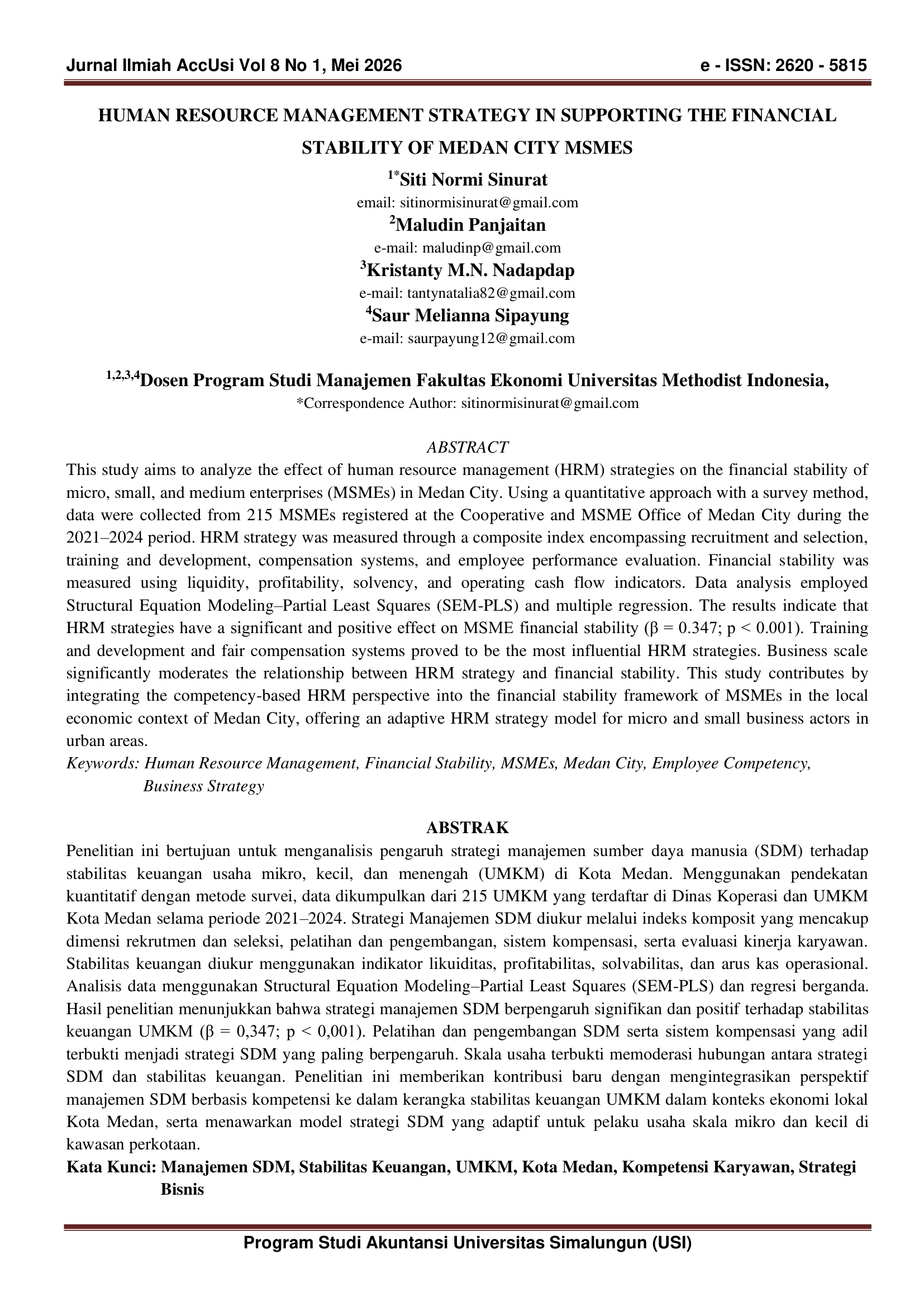
Human Resource Management Strategy in Supporting The Financial Stability of Medan City Msmes
DOI:
https://doi.org/10.36985/w4zq9285Keywords:
Human Resource Management, Financial Stability, MSMEs, Medan City, Employee Competency, Business StrategyAbstract
This study aims to analyze the effect of human resource management (HRM) strategies on the financial stability of micro, small, and medium enterprises (MSMEs) in Medan City. Using a quantitative approach with a survey method, data were collected from 215 MSMEs registered at the Cooperative and MSME Office of Medan City during the 2021–2024 period. HRM strategy was measured through a composite index encompassing recruitment and selection, training and development, compensation systems, and employee performance evaluation. Financial stability was measured using liquidity, profitability, solvency, and operating cash flow indicators. Data analysis employed Structural Equation Modeling–Partial Least Squares (SEM-PLS) and multiple regression. The results indicate that HRM strategies have a significant and positive effect on MSME financial stability (β = 0.347; p < 0.001). Training and development and fair compensation systems proved to be the most influential HRM strategies. Business scale significantly moderates the relationship between HRM strategy and financial stability. This study contributes by integrating the competency-based HRM perspective into the financial stability framework of MSMEs in the local economic context of Medan City, offering an adaptive HRM strategy model for micro and small business actors in urban areas.
Downloads
Downloads
Published
Issue
Section
License
Copyright (c) 2026 Siti Normi Sinurat, Maludin Panjaitan, Kristanty M N Nadapdap, Saur Melianna Sipayung (Author)

This work is licensed under a Creative Commons Attribution 4.0 International License.