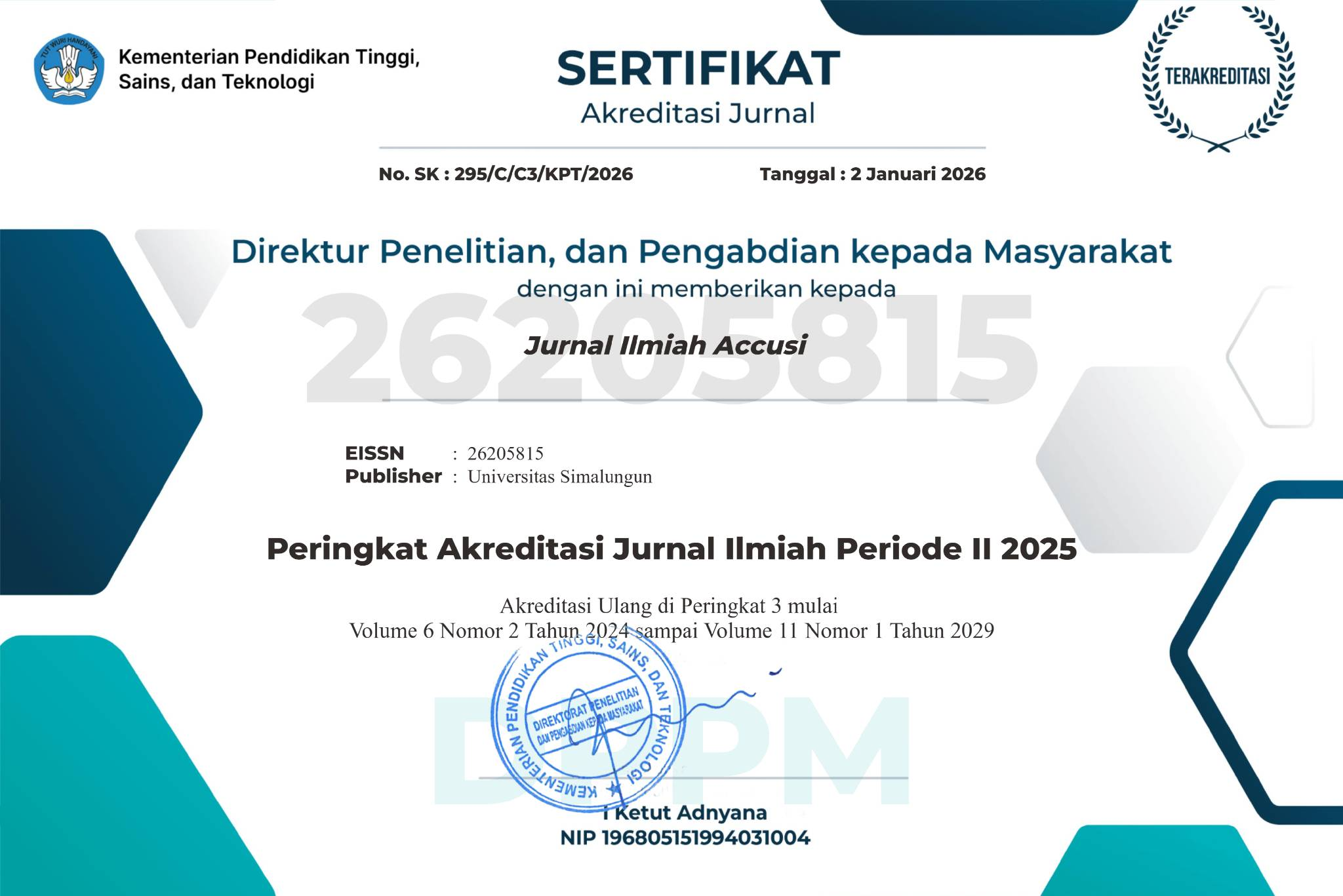
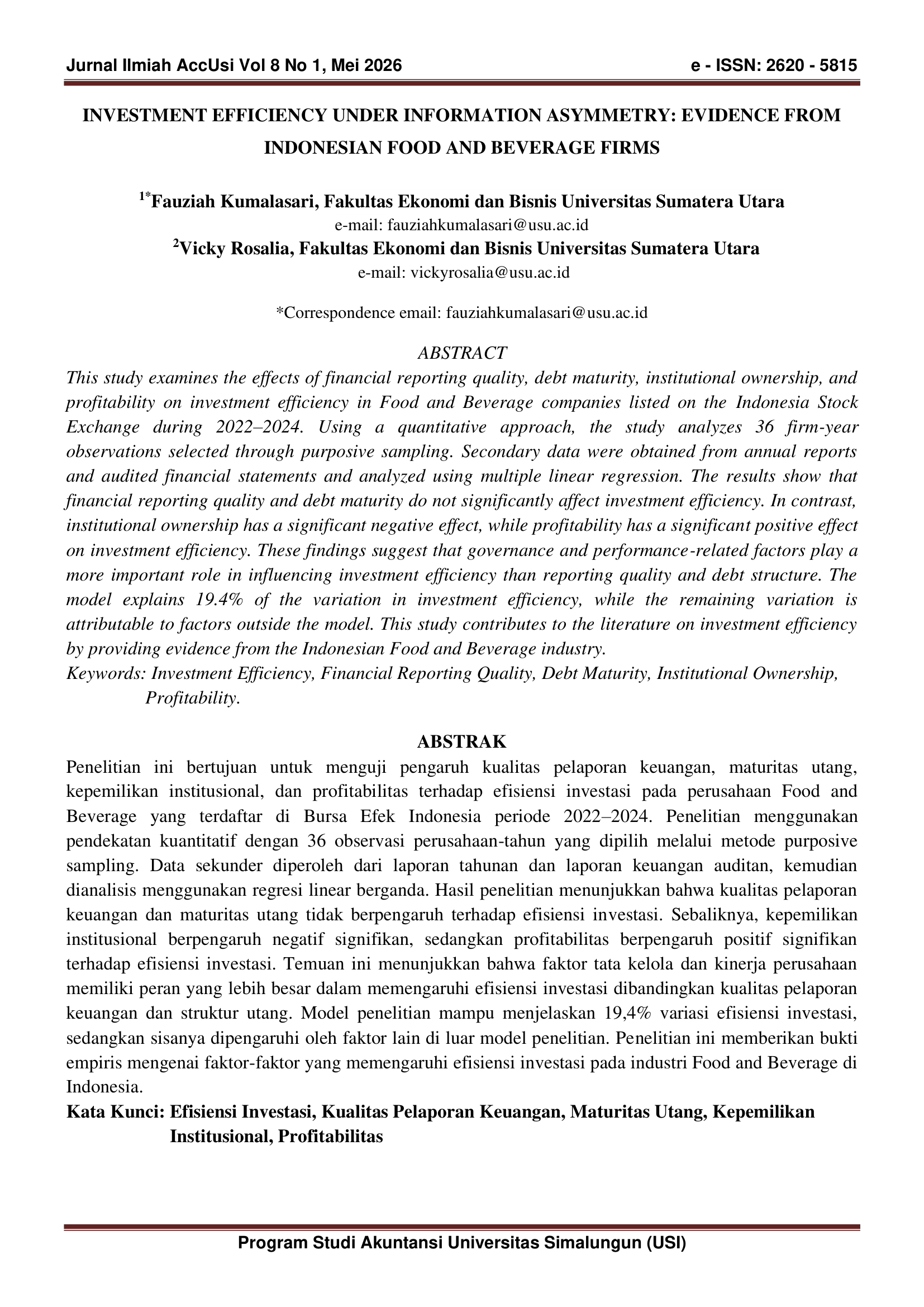
Investment Efficiency under Information Asymmetry: Evidence from Indonesian Food and Beverage Firms
DOI:
https://doi.org/10.36985/hr3jbs54Keywords:
Investment Efficiency, Financial Reporting Quality, Debt Maturity, Institutional Ownership, ProfitabilityAbstract
This study examines the effects of financial reporting quality, debt maturity, institutional ownership, and profitability on investment efficiency in Food and Beverage companies listed on the Indonesia Stock Exchange during 2022–2024. Using a quantitative approach, the study analyzes 36 firm-year observations selected through purposive sampling. Secondary data were obtained from annual reports and audited financial statements and analyzed using multiple linear regression. The results show that financial reporting quality and debt maturity do not significantly affect investment efficiency. In contrast, institutional ownership has a significant negative effect, while profitability has a significant positive effect on investment efficiency. These findings suggest that governance and performance-related factors play a more important role in influencing investment efficiency than reporting quality and debt structure. The model explains 19.4% of the variation in investment efficiency, while the remaining variation is attributable to factors outside the model. This study contributes to the literature on investment efficiency by providing evidence from the Indonesian Food and Beverage industry
Downloads
Downloads
Published
Issue
Section
License
Copyright (c) 2026 Fauziah Kumalasari, Vicky Rosalia (Author)

This work is licensed under a Creative Commons Attribution 4.0 International License.