Integrating the Technology Acceptance Model and the Theory of Planned Behavior to Explain Electric Vehicle Purchase Intention Through Willingness to Pay
DOI:
https://doi.org/10.36985/cv27q912Keywords:
Electric Vehicle, Technology Acceptance Model, Theory of Planned Behavior, Willingness to pay, Purchase intentionAbstract
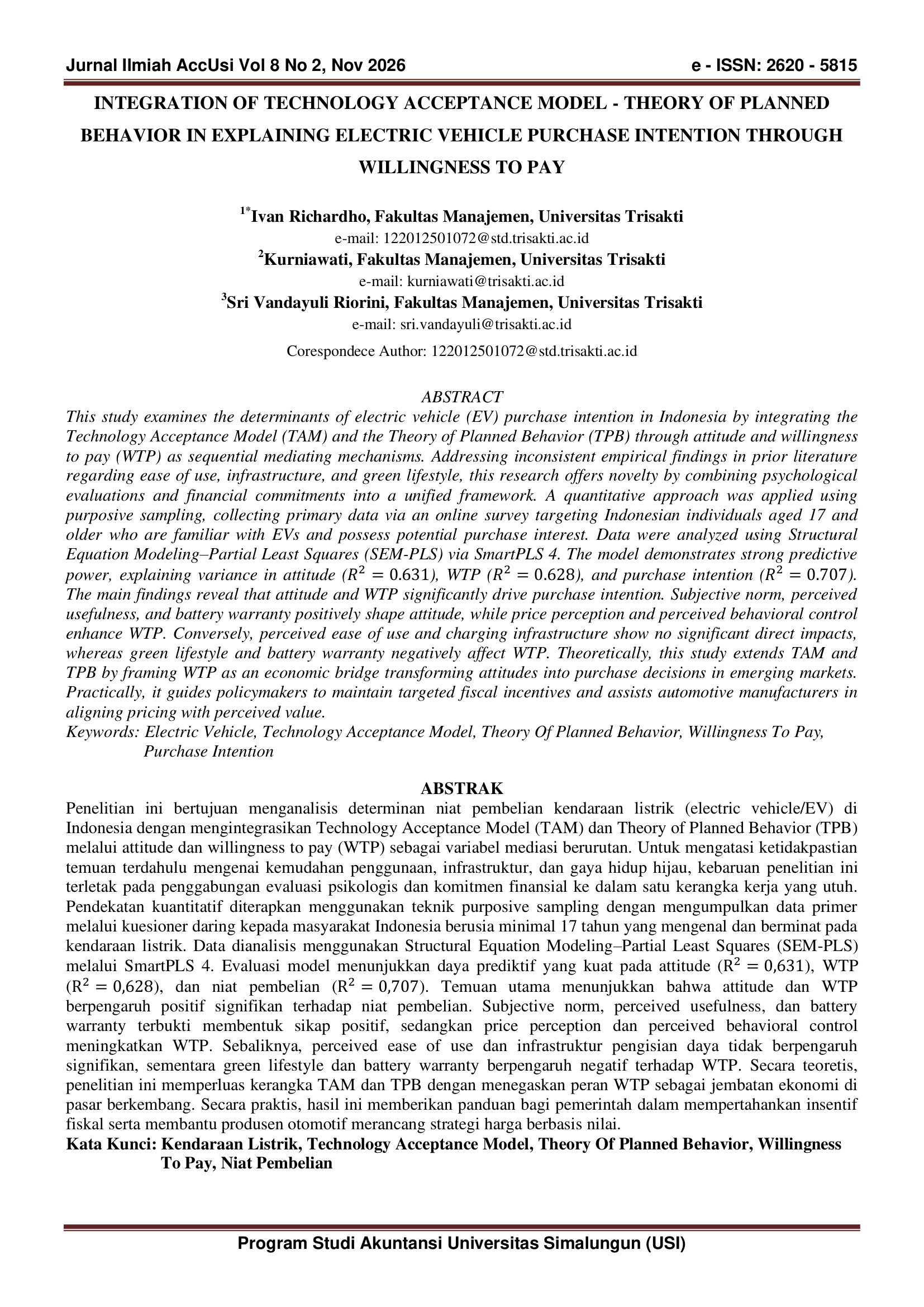
This study examines the determinants of electric vehicle (EV) purchase intention in Indonesia by integrating the Technology Acceptance Model (TAM) and the Theory of Planned Behavior (TPB) through attitude and willingness to pay (WTP) as sequential mediating mechanisms. Addressing inconsistent empirical findings in prior literature regarding ease of use, infrastructure, and green lifestyle, this research offers novelty by combining psychological evaluations and financial commitments into a unified framework. A quantitative approach was applied using purposive sampling, collecting primary data via an online survey targeting Indonesian individuals aged 17 and older who are familiar with EVs and possess potential purchase interest. Data were analyzed using Structural Equation Modeling–Partial Least Squares (SEM-PLS) via SmartPLS 4. The model demonstrates strong predictive power, explaining variance in attitude (R2 = 0.631), WTP (R2 = 0.628), and purchase intention (R2 = 0.707) The main findings reveal that attitude and WTP significantly drive purchase intention. Subjective norm, perceived usefulness, and battery warranty positively shape attitude, while price perception and perceived behavioral control enhance WTP. Conversely, perceived ease of use and charging infrastructure show no significant direct impacts, whereas green lifestyle and battery warranty negatively affect WTP. Theoretically, this study extends TAM and TPB by framing WTP as an economic bridge transforming attitudes into purchase decisions in emerging markets. Practically, it guides policymakers to maintain targeted fiscal incentives and assists automotive manufacturers in aligning pricing with perceived value.
Downloads
Downloads
Published
Issue
Section
License
Copyright (c) 2026 Ivan Richardho, Kurniawati Kurniawati, Sri Vandayuli Riorini (Author)

This work is licensed under a Creative Commons Attribution 4.0 International License.