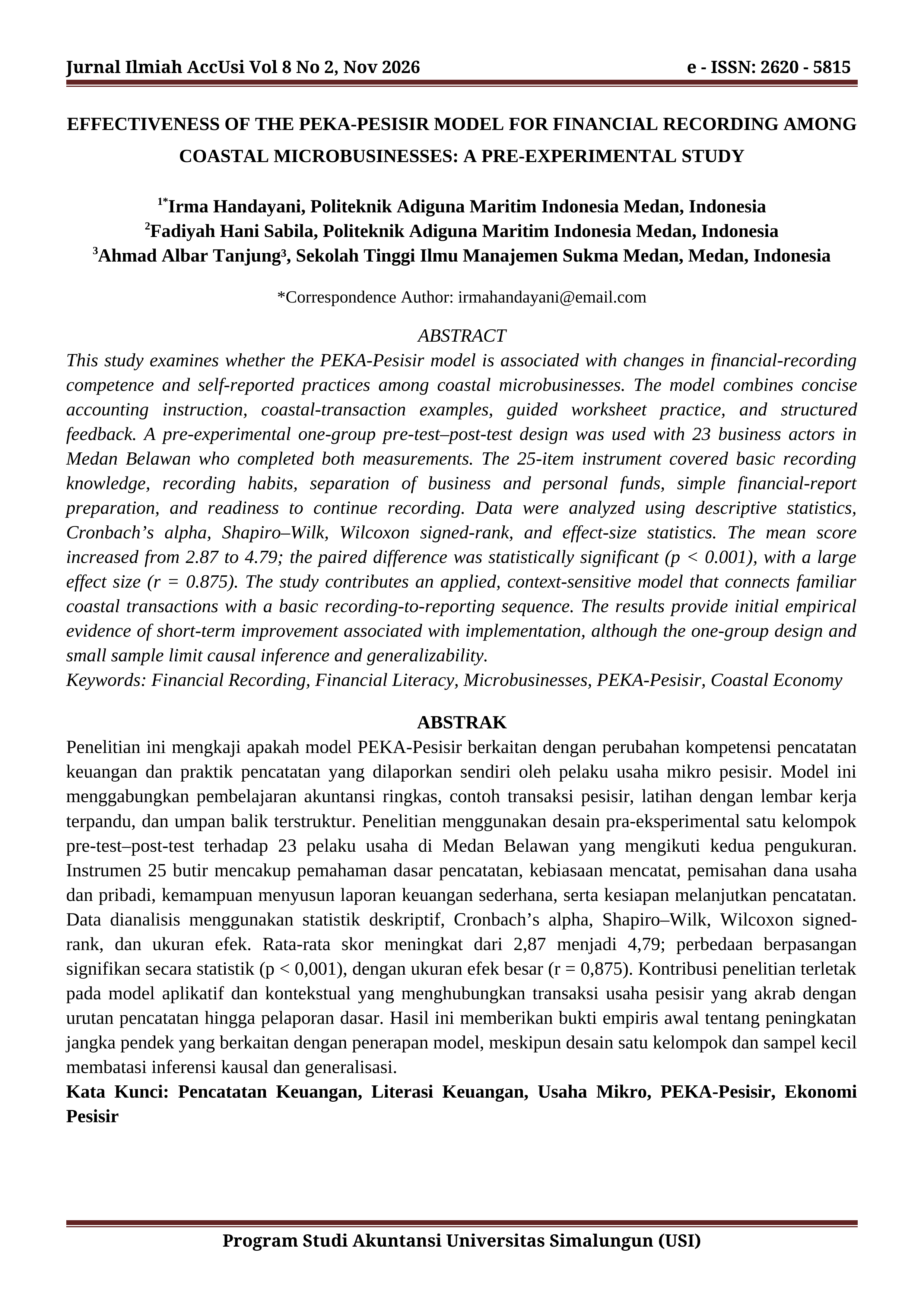
Effectiveness of the PEKA-Pesisir Model for Financial Recording among Coastal Microbusinesses: A Pre-Experimental Study
DOI:
https://doi.org/10.36985/vp4nm966Keywords:
Financial Recording, Financial Literacy, Microbusinesses, PEKA-Pesisir, Coastal EconomyAbstract
This study examines whether the PEKA-Pesisir model is associated with changes in financial-recording competence and self-reported practices among coastal microbusinesses. The model combines concise accounting instruction, coastal-transaction examples, guided worksheet practice, and structured feedback. A pre-experimental one-group pre-test–post-test design was used with 23 business actors in Medan Belawan who completed both measurements. The 25-item instrument covered basic recording knowledge, recording habits, separation of business and personal funds, simple financial-report preparation, and readiness to continue recording. Data were analyzed using descriptive statistics, Cronbach’s alpha, Shapiro–Wilk, Wilcoxon signed-rank, and effect-size statistics. The mean score increased from 2.87 to 4.79; the paired difference was statistically significant (p < 0.001), with a large effect size (r = 0.875). The study contributes an applied, context-sensitive model that connects familiar coastal transactions with a basic recording-to-reporting sequence. The results provide initial empirical evidence of short-term improvement associated with implementation, although the one-group design and small sample limit causal inference and generalizability
Downloads
Downloads
Published
Issue
Section
License
Copyright (c) 2026 Irma Handayani, Fadiyah Hani Sabila, Ahmad Albar Tanjung (Author)

This work is licensed under a Creative Commons Attribution 4.0 International License.